
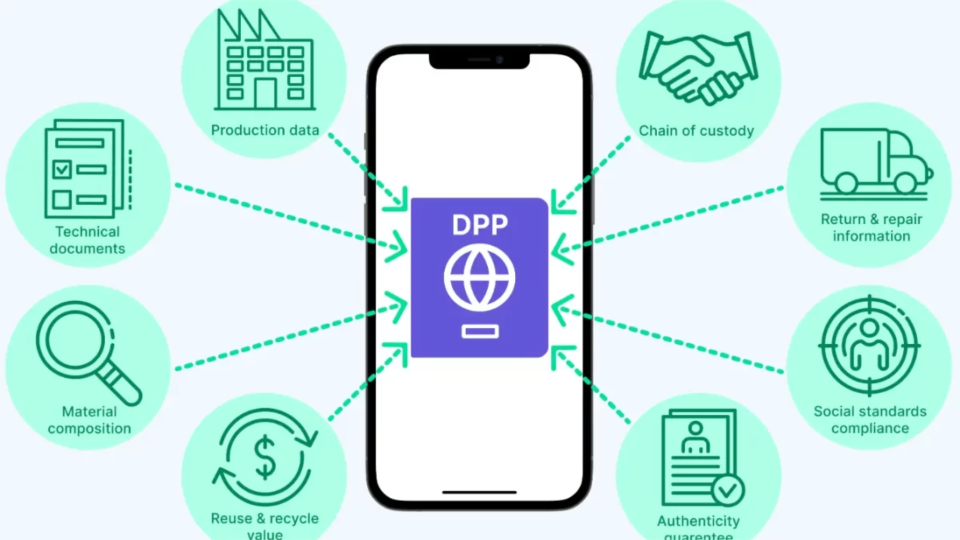
When considering where the next major opportunity in the RFID market may emerge, one of the most promising areas is currently the European Union’s Digital Product Passport (DPP). The DPP is a mandatory, machine-readable digital record required by the EU for products placed on the European market, covering information throughout the entire product lifecycle.
Current Progress of the DPP
The EU’s unified central DPP registry has now officially gone live. All product passport data must be registered in this system, where an official unique registration code is generated. The data must be retained for at least ten years.
The deadlines for mandatory DPP implementation vary by product category.
Batteries will be the first product category subject to mandatory DPP requirements, particularly large batteries with a capacity exceeding 2,000 W. Pilot implementation began in 2026, with full mandatory enforcement expected in February 2027.
For textiles and consumer electronics, full mandatory implementation is expected to begin in 2027.
Furniture, mattresses, tires, and metal construction materials are scheduled to be included in phases starting in 2028
By 2030, the DPP framework is expected to cover more than 90% of consumer products circulating within the EU.
Available DPP data carriers
It is important to emphasize that DPP implementation is not limited to RFID or NFC. Barcodes and QR codes may also be used.
For example, in the large-battery sector, where DPP implementation has already begun, barcodes and QR codes are currently the mainstream data-carrier solutions. Which product categories, then, are likely to use RFID for DPP management? One clear answer is textiles, including footwear, apparel, towels, bed sheets, duvet covers, and other textile products.
Textile industry RFID for DPP
RFID tags are already being adopted on a large scale in the textile industry. RFID-based management has therefore become deeply integrated into the industry’s existing business and operational systems.
However, there is one fundamental difference between DPP requirements and the current use of RFID tags in the footwear and apparel industry. The DPP requires products to be managed throughout their entire lifecycle, including production, logistics, sales, consumer use, and final recycling
At present, RFID tags used in footwear and apparel are mainly intended for production, logistics, and retail management. Therefore, attaching the RFID tag to the product’s hang tag is generally sufficient.
Consequently, even if RFID is adopted for DPP management in the textile industry, the new requirements will still present significant challenges for RFID tag products.
The Greatest Challenge: Surviving Repeated Washing
Washable RFID tags are already available on the market and are commonly used for linen inventory and replenishment management in hotels and hospitals. Because the commercial laundry industry uses specialized washing equipment, these laundry-tag inlays require special encapsulation, and their antennas are often made from metal wire. This type of product construction is not suitable for everyday consumer products.
Therefore, RFID tags used for textile DPP applications are likely to take two main forms.
The First Option: Integrating the RFID Tag into a Button
The main advantage of this design is that the button itself can serve as a protective enclosure, helping prevent the RFID tag from being physically damaged when the garment is washed.
However, button-type RFID tags also have obvious disadvantages. Buttons are generally small, which limits the size of the antenna and consequently reduces the tag’s read range. The button casing may further weaken the RF performance and shorten the read range.
If the tag is used only to meet DPP requirements, a shorter read range may still be acceptable, as long as the tag can be successfully read.
However, if the same tag is also expected to support supply-chain management, store operations, and inventory counting in the footwear and apparel industry, its limited read range may make it unsuitable. Efficient bulk inventory counting would become difficult.
One possible solution would be to use two RFID tags on each footwear or apparel item: a button-type RFID tag dedicated to the DPP and a hang-tag RFID label used for supply-chain and retail management.
Clearly, however, using two RFID tags would increase costs significantly and would not be an ideal solution.
The Second Option: Integrating the RFID Inlay into the Care Label
Some footwear and apparel brands are already incorporating RFID tags into garment care labels.
For care-label applications, the key challenge lies in the long-term stability of materials such as pressure-sensitive adhesives and ACP conductive adhesives. After repeated washing and the physical impact generated inside a washing machine, these materials must continue to maintain stable electrical performance as well as sufficient shear strength and bonding strength.
In addition, because the RFID chip may remain relatively exposed, additional protection or encapsulation of the chip itself may also be required.
The main advantage of the RFID care-label solution is that a single tag can support both supply-chain and retail management and the full lifecycle traceability required by the DPP.
Therefore, if the technical challenges described above can be resolved, RFID-enabled care labels are likely to become the preferred solution for the market.
FAQ: RFID Tags for DPP Compliance
What is EU DPP?
DPP stands for Digital Product Passport, a mandatory machine-readable digital record for goods sold in EU markets, covering full product lifecycle data and stored in the official central registry for at least ten years.
Does DPP only accept RFID tags?
No. DPP is not limited to RFID or NFC. Barcodes and QR codes are also acceptable data carriers, and QR / barcode solutions are currently mainstream for large battery DPP use cases.
Which product category will mainly use RFID for DPP?
Textile products including footwear, apparel, towels and bed linen are the main category suitable for DPP RFID tags, as RFID management is already widely deployed across textile supply chains.
What is the biggest difficulty for textile DPP RFID tags?
The core challenge is surviving repeated home washing cycles. Regular laundry RFID tags with metal wire antennas and special encapsulation are designed for commercial laundry and not fit for consumer textile goods.
What are the two main DPP RFID tag options for textiles?
Option one is RFID tags integrated into clothing buttons for washing protection, with the downside of shorter read range. Option two is RFID inlays embedded inside garment care labels, which can support both retail inventory and full DPP lifecycle traceability if material stability issues are solved.
Need reliable DPP RFID tag solutions for textile and apparel products? Get in touch with us to discuss washable RFID inlay design, material testing and compliance support for EU Digital Product Passport requirements. Contact our RFID engineering team →
About Our RFID Solutions
We supply customized RFID tags and inlays tailored for textile, footwear and apparel brands targeting the EU DPP regulation. Our R&D team evaluates wash resistance, adhesive stability and RF performance to help you pick the right data carrier to meet full lifecycle traceability rules.