
In July 2026, GS1 US announced the results of Operation Brilliance, an eight-week pilot jointly conducted by Walmart and Hanes, which has since been acquired by Gildan. The field trial focused on case-level traceability in the apparel supply chain. It implemented the new GS1 SSCC++ identification standard and adopted a hybrid RFID-and-QR-code labeling solution, successfully validating a standardized end-to-end shipment tracking system.
Building on its existing item-level RFID requirements for apparel, Walmart has introduced a new case-level tracking system. This expands RFID beyond its traditional use in store inventory management and could create a new source of incremental demand for RFID tags, accelerating the evolution of retail RFID from an endpoint tool into a digital infrastructure for global supply chains.
Pilot Achieves Highly Reliable Identification and Establishes a Two-Tier "Item + Case" Traceability System
The pilot involved 30,000 apparel shipping cases containing a total of 500,000 garments. The tracking process covered four critical stages: factory packing, consolidation by third-party logistics providers, regional distribution centers, and physical retail stores.
Test results showed that the RFID read rate at distribution centers reached 99.9998%, while the identification rate at retail stores remained stable at 97%. This level of accuracy is sufficient to support large-scale commercial deployment.
The most significant technical innovation was the implementation of the new GS1 SSCC++ standard together with the TDS 2.3 RFID tag data specification. This allows shipping-case labels to carry web-address information, enabling each case to report its location and provide a list of the products contained inside.
The solution uses RFID and QR codes on the same label. This ensures compatibility with legacy barcode-scanning equipment, allowing companies to avoid the immediate large-scale replacement of existing readers and significantly reducing the cost of supply-chain digitalization.
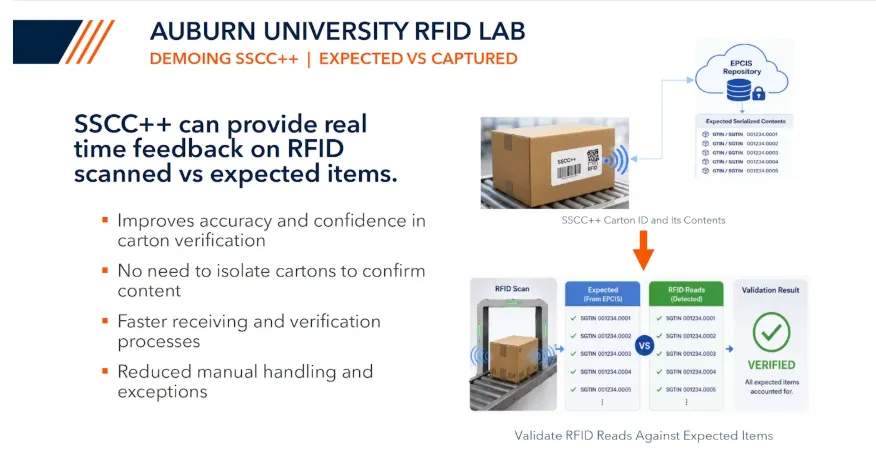
Historically, Walmart’s RFID requirements have focused primarily on assigning unique identifiers to individual apparel hang tags, mainly to support in-store inventory counting and shrinkage control. This pilot marks an upgrade in Walmart’s supply-chain digitalization strategy by establishing a two-tier traceability architecture that creates a one-to-one association between an item-level SGTIN and its corresponding case-level SSCC.
At the shipping-case stage, goods can be verified automatically without manually opening each case and counting its contents. This substantially reduces commercial disputes caused by shortages and incorrect shipments, improves on-shelf product availability, and creates a complete closed-loop system combining end-to-end upstream logistics tracking with precise item-level management at the retail endpoint.
From an industry perspective, apparel supply chains involve highly complex SKU structures and lengthy cross-border logistics processes. Product losses and reconciliation disputes have long been persistent challenges for brands and retailers. The two-tier RFID system connects logistics and retail data, directly addressing the industry’s longstanding lack of shipment visibility. It therefore offers considerable potential for replication and widespread adoption.
Standardized Solution Has Strong Potential for Wider Adoption, Creating a New Demand-Growth Window for the RFID Industry
This pilot is more than a project involving a single company. Its greater significance lies in the creation of a scalable, standardized solution that could be adopted across the North American retail supply chain.
The entire data architecture is based on a unified EPCIS data-sharing system, replacing the traditional model in which brands, logistics providers, and retailers develop customized point-to-point integrations with one another. This substantially reduces the technical cost of connecting and sharing data among multiple parties.
The market is closely watching whether Walmart will formally include case-level RFID labeling in its mandatory supplier requirements. If it does, large numbers of domestic and international apparel suppliers will need to update their labeling solutions accordingly, directly driving growth in orders for UHF RFID tags.
From a global perspective, apparel retail has long been the largest downstream application market for passive UHF RFID. Data show that apparel retail accounted for more than 54% of global RFID tag market revenue in 2025. North America, which has the world’s highest RFID adoption rate in the apparel sector, continues to experience steady market growth.
Previous estimates of retail RFID demand were generally limited to item-level hang tags. Once case-level tracking becomes widely adopted, every outbound shipping carton will require an additional RFID tag. Combined with the enormous volume of apparel shipments in North America, this could generate a significant increase in total tag demand.
If the GS1 SSCC++ standard is subsequently adopted by other major North American retail chains, such as Target and Macy’s, it could create an industry-wide diffusion effect and continue to generate medium- and long-term overseas purchasing demand.
At the industry-chain level, this development could create structural opportunities across multiple segments. UHF RFID tag and inlay manufacturers that meet Walmart’s qualification requirements, hold ARC certification, and possess reliable export and delivery capabilities are likely to benefit first.
Demand for upstream UHF RFID chips would rise accordingly, potentially supporting sustained growth in shipment volumes for chip manufacturers. Suppliers of RFID readers, middleware, and supply-chain system integration services would also gain additional business opportunities.
In the long term, the fundamental logic driving retail RFID adoption is changing. Demand is expanding beyond in-store inventory control to encompass cross-border logistics, goods-receipt reconciliation, and end-to-end shipment visibility, substantially raising the industry’s long-term growth potential.
Potential uncertainties should also be considered objectively. A successful pilot does not necessarily mean that full-scale commercial deployment will begin immediately. Walmart has not yet announced a mandatory implementation timetable for case-level RFID.
Adding RFID labels to shipping cases will also slightly increase packaging costs for apparel brands, and implementation schedules may vary among manufacturers. In addition, competition in the passive RFID tag industry remains intense, while price fluctuations may affect the profitability of companies throughout the value chain.
Overall, this pilot represents an important catalyst for the RFID industry. Walmart’s subsequent policy implementation, together with the adoption progress of other international retailers, will be among the key indicators used to assess the sector’s future growth and business momentum.
World First for the Pharmaceutical Industry: Pfizer Launches Standardized Medicines with RFID Tags Applied at the Source
In July 2026, global pharmaceutical company Pfizer partnered with healthcare intelligence solutions provider Bluesight to officially launch standardized injectable medicines featuring factory-applied SmartDose™ RFID technology.
This initiative establishes a new benchmark for digital pharmaceutical traceability. Pfizer has become the world’s first pharmaceutical company to implement item-level RFID tagging at the source, encoding verification, and standardized deployment on a large commercial scale.
Throughout the pharmaceutical industry’s digital transformation, conventional RFID applications have continued to face significant limitations. Most existing solutions cover only batch tracking at the shipping-case or pallet level, or depend on hospital pharmacies to manually apply secondary RFID labels and enter the corresponding information.
These conventional approaches create numerous problems, including low operational efficiency, high error rates, and inconsistent standards.
Through this breakthrough, Pfizer has moved the deployment of intelligent RFID labels upstream to the pharmaceutical manufacturing stage. Each medicine now leaves the factory with its own standardized digital identity.
This fundamentally transforms traditional pharmaceutical traceability and inventory-management practices, establishing a new industry benchmark for intelligent item-level medicine management and compliant end-to-end traceability across the global pharmaceutical supply chain.
FAQ: RFID Case Tracking and Standardized Tags
What is Operation Brilliance?
Operation Brilliance is an eight-week pilot jointly conducted by Walmart and Hanes, announced by GS1 US in July 2026. It focused on case-level traceability in the apparel supply chain using the new GS1 SSCC++ standard and a hybrid RFID-and-QR-code labeling solution.
What read rates did the Walmart pilot achieve?
The RFID read rate at distribution centers reached 99.9998%, while the identification rate at retail stores remained stable at 97%, a level of accuracy sufficient to support large-scale commercial deployment.
What is the GS1 SSCC++ standard?
SSCC++ is a new GS1 identification standard implemented together with the TDS 2.3 RFID tag data specification. It allows shipping-case labels to carry web-address information, enabling each case to report its location and provide a list of the products contained inside.
Why combine RFID and QR codes on the same label?
Using RFID and QR codes together ensures compatibility with legacy barcode-scanning equipment, allowing companies to avoid the immediate large-scale replacement of existing readers and significantly reducing the cost of supply-chain digitalization.
How does case-level RFID affect UHF RFID tag demand?
Once case-level tracking is widely adopted, every outbound shipping carton will require an additional RFID tag beyond the item-level hang tag. Combined with the huge volume of North American apparel shipments, this could generate a significant increase in total UHF RFID tag demand.
Why is Pfizer launching RFID-tagged medicines?
In July 2026, Pfizer partnered with Bluesight to launch standardized injectable medicines featuring factory-applied SmartDose RFID technology, making Pfizer the world's first pharmaceutical company to implement item-level RFID tagging at the source, moving digital identity upstream to the manufacturing stage.
Looking for reliable UHF RFID tags for apparel case-level or item-level tracking? We supply high-performance, ARC-qualified RFID tag and inlay solutions for retail supply-chain deployment and EU-compliant traceability. Contact our RFID team →
About Our RFID Solutions
We supply customized RFID tags , inlays and label production support for apparel, footwear and pharmaceutical brands pursuing item-level and case-level traceability. Our engineering team helps you select the right UHF tag configuration and encode compliance data to meet global retail and regulatory standards.